US Denies Visas to Some Iranian Delegation Members for UNGA
While President Pezeshkian and Foreign Minister Araghchi received visas, other key Iranian delegation members were denied entry to the US.
By Grace Whitfield · First published 17 Sept 2026
In brief
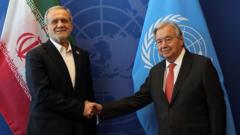
- Iranian President Masoud Pezeshkian and Foreign Minister Abbas Araghchi have arrived in New York for the United Nations General Assembly.
- Several members of the Iranian delegation, including its communications team, were denied US visas and are not attending.
- Iran has proposed reopening the Strait of Hormuz within seven days if the US eases military pressure and lifts its blockade.
- US officials say they are open to meetings with Iranian officials at the UN, though no talks are confirmed yet.
- Iranian officials continue to criticize the US for imposing strict travel restrictions and limiting their delegation's participation.
Timeline · 10 moments
US confirms visas for Iranian leaders to attend UN Assembly
Arab News ↗Iranian President and Foreign Minister named as part of delegation
BBC World ↗Delegation size smaller than previous years with travel restrictions
The Hindu ↗US bars purchase of luxury goods by Iranian delegates
Top World News- News18.com ↗Iranian president's attendance at General Assembly confirmed
NDTV Top Stories ↗US formally grants visas to Iran's top leaders for UNGA
Top World News- News18.com ↗US denies visas to part of Iran's UN delegation
Arab News ↗Iranian foreign minister arrives in New York for UNGA
IRNA English ↗Iran offers to reopen Hormuz if US eases pressure
Arab News ↗US open to meeting Iranian officials at UN
Middle East Eye ↗Update 22 Sept 2026, 2:35 pm UTC
Iranian President Masoud Pezeshkian and Foreign Minister Abbas Araghchi have both arrived in New York for the UN General Assembly, but several delegation members remain absent after being denied US visas. Iran has offered to reopen the Strait of Hormuz within seven days if the US eases military pressure and lifts the blockade on Iranian ports. US officials say they are open to meetings with Iranian officials on the sidelines of the UNGA, while Iran continues to criticize US travel restrictions.
Update 22 Sept 2026, 8:14 am UTC
Iranian Foreign Minister Abbas Araghchi has arrived in New York for the UN General Assembly, marking the first visit by a high-ranking Iranian official since the start of the war. Iranian President Masoud Pezeshkian is scheduled to address the General Assembly on Wednesday, and the delegation continues to face tight restrictions during their stay.
Update 21 Sept 2026, 7:44 pm UTC
The US has denied visas to some members of the Iranian president's delegation, including his communications team, while granting visas to President Pezeshkian and Foreign Minister Araghchi. Iranian officials have criticized the restrictions as unprecedented and hostile. The Iranian president is scheduled to leave Tehran for New York on Tuesday.
Update 18 Sept 2026, 2:59 pm UTC
The US has formally granted visas to Iranian President Masoud Pezeshkian and Foreign Minister Abbas Araghchi to attend the UN General Assembly in New York next week. The Iranian delegation will be smaller than last year, and all members will face movement restrictions while in the US.
Update 18 Sept 2026, 3:59 am UTC
Recent coverage confirms that the Trump administration has granted visas for Iranian President Masoud Pezeshkian and Foreign Minister Abbas Araghchi to attend the UN General Assembly next week. The delegation will be subject to travel restrictions while in New York.
How it started
Each September, world leaders gather in New York for the United Nations General Assembly. The US, as host country, is required to grant entry to foreign delegations attending these meetings, but it sometimes delays or restricts visas for political reasons.
This year, tensions between the US and Iran have been especially high due to a war that has lasted over six months. Previous years saw disputes over which Iranian officials could attend, reflecting the broader diplomatic rifts.
How it unfolded
On September 17, a US State Department spokesman confirmed that the US would allow a delegation from Iran to attend the UN General Assembly in New York. The announcement included confirmation that visas had been approved for key figures such as President Masoud Pezeshkian and Foreign Minister Abbas Araghchi.
Sources clarified that the Iranian group would be smaller than in previous years. Officials also highlighted that the delegation would face strict travel limitations, restricting their movement to the immediate area around the UN and their accommodations. They are also barred from buying luxury goods and certain other items while in the US.
This move is notable given the ongoing conflict involving Iran, which has shaped diplomatic interactions for months. Some observers noted that the US decision contrasts with its denial of a visa to Palestinian Authority President Mahmoud Abbas for the same event.
Despite the broader geopolitical tensions, the decision to allow Iranian participation was expected by some, as denying entry could have drawn international criticism and complicated UN processes.
Where it stands
The Iranian delegation's participation at the UN General Assembly is now confirmed, with preparations for their arrival underway. The US has reiterated that travel and purchasing restrictions will be enforced throughout their stay.
The meetings are set to begin next week, and Iranian officials will join other world leaders in high-level discussions, despite the ongoing war and strained relations.
What to watch
Attention will turn to the speeches and diplomatic interactions involving the Iranian delegation during the General Assembly. Observers will be looking for any signs of diplomatic shifts or new statements on the ongoing conflict and US-Iran relations.
More in Politics
All →
Serbian President Aleksandar Vucic Resigns Ahead of Parliamentary Elections, Eyes Prime Minister Role
Aleksandar Vucic has stepped down as Serbia's president just before early elections, setting the stage for a possible transition to prime minister and a major shift in the country's leadership.
17 sources · today
Andy Burnham Faces Early Tests as UK Prime Minister Amid Labour Unrest
Andy Burnham's first weeks as UK Prime Minister have been shaped by high-profile diplomacy, internal Labour divisions, and a refusal to call an early election, setting the stage for his first party conference.
15 sources · over 6 days
Supreme Court Blocks Missouri GOP Congressional Map for Third Time
The US Supreme Court has again halted Missouri Republicans from using a favored congressional map, leaving the state's redistricting unresolved as midterm elections approach.
11 sources · over 2 days